
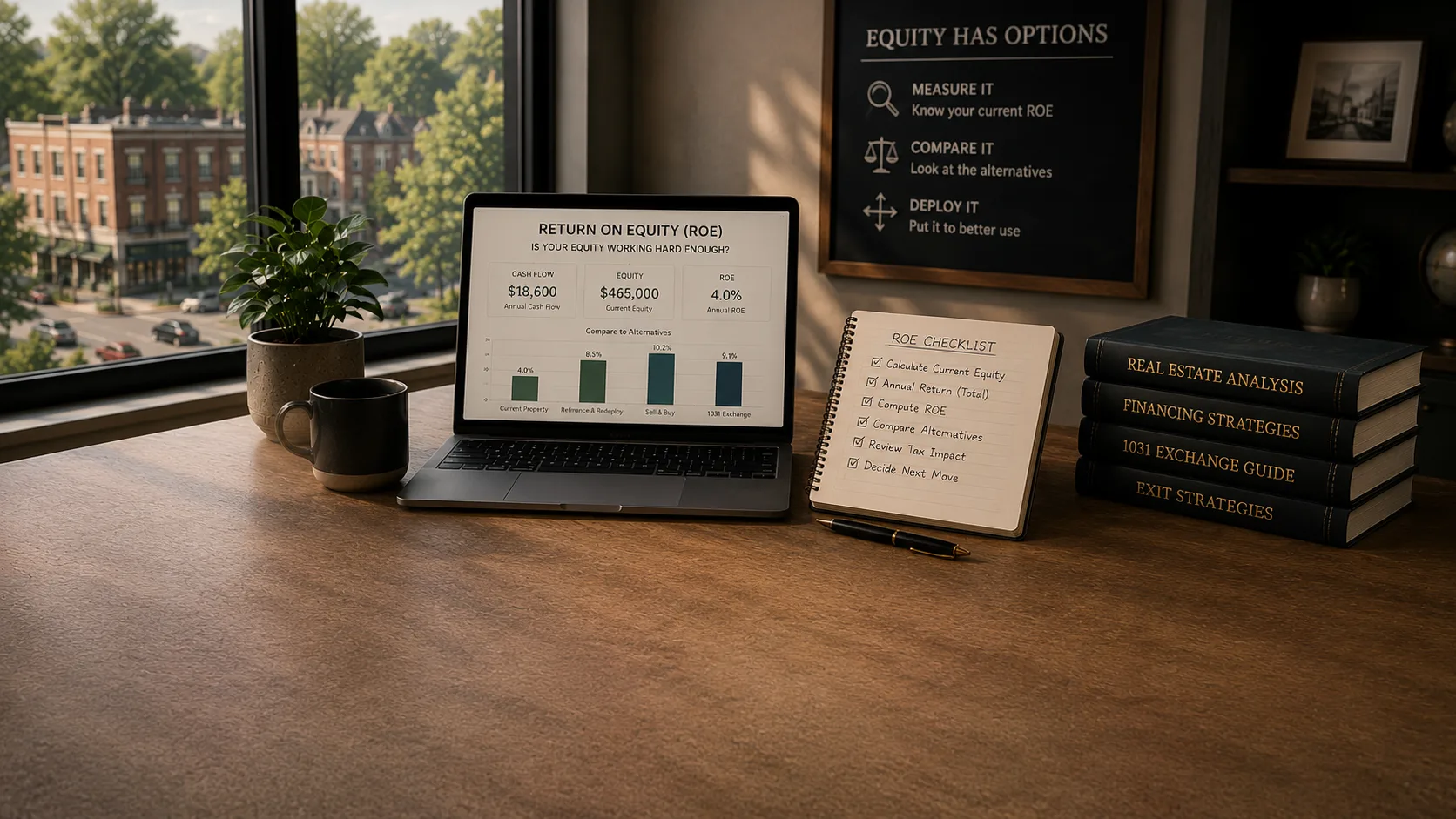
Find Out When Your Equity Stops Working Hard Enough
The return on a property you've owned for years quietly shrinks as your equity grows. ROE is the annual check that tells you when it may be time to compare holding, refinancing, selling, or exchanging — instead of letting dead equity sit.
The Team You Should Be Using
For this topic, you'll want:
- CPA (with real estate specialization) — for the after-tax picture
- Lender — to price a cash-out refinance against the alternatives
- Real Estate Advisor (us) — to estimate current value, review rent growth, and compare holding, refinancing, selling, or exchanging
Most investors check the return on a property the day they buy it and never check again. That's a mistake that compounds quietly. As you pay down the loan and the property appreciates, your Equity In real estate investing, equity is the difference between a property's current market value and the balance owed on it. Equity grows through loan paydown and appreciation, and it's the denominator in return on equity (ROE). in it grows — but the income it produces usually doesn't grow nearly as fast. The result is a property that looks like a winner on paper while the actual return on the money trapped inside it slowly drops below what that money could earn somewhere else. ROE is how you catch it.
What return on equity is
In real estate investing, Return on Equity (ROE) Return on equity (ROE) is an investor's annual return measured against the equity they currently have in a property — not the cash originally invested. As equity grows through loan paydown and appreciation, ROE reveals how hard that current equity is working today. The numerator can be defined as cash flow only or as total return (cash flow plus principal reduction, and optionally appreciation); the discipline is defining it consistently before comparing properties. is your annual return measured against the equity you currently have in a property — not the cash you originally invested. The formula is straightforward: annual return divided by current equity. ROE can be calculated as a cash-flow ROE (cash flow only) or a total-return ROE (cash flow plus principal reduction, and optionally appreciation) — the important part is defining the numerator consistently before comparing one property against another. As equity grows through loan paydown and appreciation, the denominator gets bigger, so the same dollar of return represents a smaller and smaller percentage. ROE is the number that tells you how hard your current equity is working, today — not how good the deal looked the day you bought it.
ROE is not ROI — and the difference is the whole point
This is the distinction most investors miss. Return on Investment (ROI) Return on investment (ROI) is an investor's return measured against the original cash invested — a figure fixed at the moment of purchase. ROI reflects how the purchase performed; it differs from return on equity, which measures return against current equity. measures your return against your original cash invested — a number frozen at the moment of purchase. Return on equity measures your return against the equity you have now. Early on, they're close. But years into ownership, after appreciation and loan paydown, they diverge sharply. A property can show a fantastic ROI based on your original down payment while delivering a mediocre ROE on the large pile of equity now sitting inside it. ROI tells you how the purchase went. ROE tells you whether to keep your money there.
How to read your ROE
Run the number annually. Take your annual return — Cash Flow Cash flow is the money left after subtracting debt service from net operating income — the amount that actually reaches the investor's pocket. Positive cash flow means the property pays the owner to hold it; negative cash flow means the owner funds it each month. plus Principal Reduction Principal reduction is the portion of each mortgage payment that pays down the loan balance, building equity whether or not the property appreciates. It's a real return, but it's tracked separately from cash-on-cash return, as part of total return and equity buildup. , and you can layer in appreciation if you want the fuller picture — and divide it by your current equity (today's market value minus what you still owe). Then compare that percentage against what the same equity could earn elsewhere: another property, the broader market, even a safer benchmark. The comparison is the whole exercise. A 4% ROE isn't inherently bad — but if that same equity could be working at 10% in a different property, you're leaving real money on the table every year you don't act — assuming that better return is actually available after costs, taxes, and risk.
What a low ROE is telling you
A declining ROE usually means equity has built up faster than income — which is common in appreciating markets. It's not a signal that the property is bad. It's a signal that your equity has options. The three most common responses: refinance and pull equity out to redeploy, sell and move the equity into a higher-returning property, or 1031 Exchange A 1031 exchange lets an investor defer capital gains tax by reinvesting the proceeds from the sale of an investment property into a like-kind replacement property, following strict IRS rules and deadlines. It defers the gain — it does not eliminate it. Requires a qualified intermediary and strict 45- and 180-day deadlines. Educational only — consult a CPA and qualified intermediary. into something larger to defer the tax while you do it. Which one fits depends on your goals, your tax position, and the market — but the trigger is the same: the ROE check that tells you the money could be working harder.
Common mistakes
The biggest mistake is never recalculating — treating the purchase-day return as if it's permanent. After that: confusing ROE with ROI and feeling great about a number that no longer reflects reality. Forgetting that trapped equity has an Opportunity Cost Opportunity cost is the return an investor gives up by leaving capital where it is instead of deploying it elsewhere. It's the core idea behind a return-on-equity review: trapped equity has a cost even when a property cash-flows fine. even when the property cash-flows fine. And reacting to a low ROE without running the alternative — pulling equity out only makes sense if the redeployed money actually earns more after costs.
How we use ROE with investors
We run an ROE check as part of a periodic portfolio review — not to push a transaction, but to surface the question most investors never ask: is this equity still working as hard as it could be? Sometimes the answer is yes, hold. Sometimes it's refinance, sell, or exchange. The point isn't to be in motion constantly — it's to make sure inertia isn't quietly costing you a better return year after year.
A note on the numbers
ROE isn't governed by an IRS rule or a lender standard — it's a financial measure, and the math is the math. What does carry outside rules is what you do after the ROE check: a Cash-Out Refinance A cash-out refinance lets an investor access a property's equity by replacing the existing loan with a larger one and taking the difference in cash, while keeping the property. Because borrowed money isn't income, it's often a tax-deferred way to redeploy equity. Tax treatment depends on circumstances. Educational only — consult a CPA. is underwritten to lender standards, and a sale or 1031 exchange carries tax consequences your CPA and a qualified intermediary need to handle. ROE tells you to look. The professionals tell you how to act.
Related terms
Related real estate investment terms: return on equity (ROE), return on investment (ROI), equity, cash flow, principal reduction, appreciation, opportunity cost, cash-out refinance, 1031 exchange, portfolio review, total return.
When did you last check what your equity is actually earning?
If you've owned a property for a few years and never recalculated the return on the equity sitting inside it, that's worth a look. We run ROE as part of a portfolio review — no pressure to transact, just an honest read on whether your money could be working harder.